
.png)
WHO SAID LEPROSY DOESNꞌ T EXIST IN THE WORLD ?
QUIEN DIJO QUE NO HAY LEPRA EN EL MUNDO HOY DIA ?


UPDATED 2026
LEPROSY FIGURES IN THE WORLD YEARS 2023 - 2024.
PFor many people in Venezuela and around the world, leprosy, or Hansen's disease, simply doesn't exist. Because, they claim, "a vaccine was invented" a long time ago, which is completely false. Just as false as saying that aliens live among us and are going to invade.
1.) THE EVIDENCE:
If that concept were TRUE, I would not present these cases: a 23-year-old young man who came voluntarily to my office, in 2011, with erythematous-squamous plaques on his forearm, arm, and right hand with loss of sensitivity to cold and heat.
The young man told me: I do not feel cold, or heat, or when I hit myself. He pulled out his thumbnail because it bothered him, using pliers, and he did not feel pain. The photos speak for themselves.
Areas of skin where hair is lost, cutaneous anesthesia, loss of sensitivity, and difficulty moving the limb. The Mycobacterium leprae had already invaded his nerves. Areas of ulceration due to blows. Erythematous-squamous plaques where the difference between healthy and affected skin can be clearly seen.
Diagnosis: tuberculoid leprosy (Borderline Tuberculoid). (BT)
I referred him to the public dermatology service and requested a counter-referral: the response was a sentence:
Tuberculoid leprosy (BT), treatment already started. They told him a year and a half of treatment. They did not mention any vaccine.
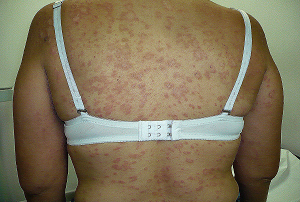
The second case seen at the CENTRAL HOSPITAL of MARACAY, year 2024, an older adult with the following lesions: Leonine facies (typical of leprosy), loss of the tail of the eyebrows, enlargement of the auricular pinnae, diffuse erythematous-squamous plaques on the body with loss of sensitivity, functional disability of hands and feet, with plantar perforating ulcer.
Diagnosis: Diffuse Lepromatous Leprosy (LL) with functional disability.
How long are they going to continue with that fairy tale???? How long are you going to keep lying to the world that in Venezuela a vaccine against leprosy was invented, when that is totally false. How long is WHO going to keep lying about it saying that there is practically no leprosy in the world.
The W.H.O. can say that compared to the LAST CENTURY the cases have decreased; in fact, they have a "ZERO LEPROSY" plan for the year 2030.
The figures on leprosy published annually by the Pan American Health Organization and the C.D.C are COMPLETELY real.
Why do they not acknowledge that antibiotics such as OFLOXACIN, CLARITHROMYCIN, AMOXICILLIN and CLAVULANIC ACID eliminate, kill Mycobacterium leprae. Those antibiotics put an end to the myth that the Hansen bacillus IS INDESTRUCTIBLE and that the vaccine never existed.
What existed or exists is an immunotherapy, totally different from a vaccine, which, in view of its failure, stopped being used in Venezuela, and IS NOT USED in any region or country on planet Earth.
But what I want you to reflect on is not this terminology, it is the fact that the difference in time between the two cases is 13 years, and the first case is "milder" than the second from the year 2024, which represents the most severe end of the spectrum in terms of the CLASSIFICATION of the types of LEPROSY.
LEPROSY STILL EXISTS IN VENEZUELA AND THE WORLD AND THERE IS NOT AND THERE HAS NEVER BEEN SUCH A VACCINE.
The treatment that was prescribed to these patients was the CLASSIC: Multi Drug Therapy (MDT), which was put into practice more than 60 years ago: DIAMINO-DIPHENYL-SULFONE or DDS, RIFAMPICIN and CLOFAZIMINE, CLASSIC treatment and used TODAY, 2026, THROUGHOUT THE WORLD.
And if a vaccine existed... WHY IS IT NOT GIVEN TO THE ENTIRE SUSCEPTIBLE POPULATION? TO prevent the appearance of the disease?
QUITE SIMPLY: BECAUSE IT DOES NOT EXIST! The most advanced today regarding the "VACCINE" against LEPROSY is INDIA; at the end you have the link.
2.) THE FIGURES FOR THE YEARS 2023 AND 2024:
Now I'm going to list the cases reported by the CDC and the WHO that were reported in the years 2024 and 2024.
Most Affected Countries (2024 vs. 2023, with G2 Disabilities)
| Country | Cases 2024 | Cases 2023 | Change % | G2 2024 | % G2 2024 | G2 2023 | % G2 2023 |
|---|---|---|---|---|---|---|---|
| India | 100,957 | 105,000 | -3.8% | ~5,300 est. | 5.3% | ~5,500 est. | 5.2% |
| Brazil | 22,129 | 23,500 | -5.8% | ~1,200 est. | 5.4% | ~1,300 est. | 5.5% |
| Indonesia | 14,698 | 15,200 | -3.3% | ~800 est. | 5.4% | ~850 est. | 5.6% |
| Others (>1,000 cases) | ~35,000 | ~38,000 | -8% | ~1,800 est. | 5.1% | ~2,000 est. | 5.3% |
| Global Total | 172,717 | 182,815 | -5.5% | 9,124 | 5.3% | 9,729 | 5.3% |
Note: G2 disabilities stable at ~5.3% in both years (rate 1.1–1.2/million); that is, disabilities in both years are almost the same, there was no decrease from 2023 to 2024. Country figures estimated proportionally. Multibacillary cases = higher risk.
Grade 2 disability (G2) in leprosy refers to visible and irreversible deformities present at the time of diagnosis of new cases.
Disabilities due to the long-term effects of Mycobacterium Leprae infection are reported in three categories:
G2: Visible deformities without intervention (e.g. chronic ulcers, claw hand/feet, bone resorption, facial-nasal collapse).
G1: Nerve damage without visible deformity (sensory-motor only).
G0: No disability.
Although it is true that cases decreased from 182,815 global annual cases in 2023 to 172,717 in 2024, this table shows you OBJECTIVELY that there is still LEPROSY in the world.
Now I am going to show you the countries that reported 1,000 (one thousand) cases or more per country in those years, 2024 compared with 2023.
Cases >1,000 per Country (2024 vs 2023 with Global %)
| Country | Cases 2024 | Global % 2024 | Cases 2023 | Global % 2023 |
|---|---|---|---|---|
| Bangladesh | 3,800 | 2.2% | 4,000 | 2.2% |
| D.R. Congo | 4,500 | 2.6% | 5,000 | 2.7% |
| Ethiopia | 3,500 | 2.0% | 3,000 | 1.6% |
| Madagascar | 3,000 | 1.7% | 3,300 | 1.8% |
| Mozambique | 2,500 | 1.4% | 2,700 | 1.5% |
| Myanmar | 3,000 | 1.7% | 3,300 | 1.8% |
| Nepal | 2,000 | 1.2% | 2,500 | 1.4% |
| Nigeria | 3,500 | 2.0% | 4,000 | 2.2% |
| Philippines | 3,500 | 2.0% | 3,300 | 1.8% |
| Somalia | 1,500 | 0.9% | 1,700 | 0.9% |
| Sri Lanka | 1,800 | 1.0% | 2,100 | 1.1% |
| SUBTOTAL | ~35,100 | ~20.3% | ~38,600 | ~21.1% |
| Top 3 (India/Brazil/Indonesia) | 137,784 | 79.8% | 143,576 | 78.5% |
| GLOBAL TOTAL | 172,717 | 100% | 182,815 | 100% |
Note: Percentages calculated by dividing country cases/total global cases. These 12 countries represent approximately ~20% of global cases in both years, remembering that in the Top 3 the countries India, Brazil and Indonesia account for 80% of the cases.
CURRENT LEPROSY TREATMENT W.H.O.:
The World Health Organization, as of 2026, has summarized the treatment of LEPROSY or HANSEN’s disease into two TYPES, based on the bacillary "load" of Mycobacterium Leprae that the patient has: PAUCIBACILLARY and MULTIBACILLARY.
The drug CLOFAZIMINE (LAMPREN), classically used in treatment, is only used in MULTIBACILLARY LEPROSY because of its bacteriostatic effect.
WHO Treatment Scheme: Leprosy Multidrug Therapy
| Type | Duration | MONTHLY supervised dose | DAILY self-administered dose |
|---|---|---|---|
| PAUCIBACILLARY (PB) | 6 months |
Rifampicin 600mg **+ Dapsone 100mg** |
**Dapsone 100mg** |
| MULTIBACILLARY (MB) | 12 months |
Rifampicin 600mg Clofazimine 300mg **+ Dapsone 100mg** |
Clofazimine 50mg **+ Dapsone 100mg** |
Note: Free via WHO/Novartis. Doses adjusted by weight in children. Completing the regimen prevents resistance. Type 1/2 reactions require corticosteroids/thalidomide.
Criteria used by W.H.O. to classify LEPROSY as Paucibacillary and Multibacillary:
WHO Classification: Paucibacillary (PB) vs Multibacillary (MB)
| Criterion | PAUCIBACILLARY (PB) | MULTIBACILLARY (MB) |
|---|---|---|
| Skin lesions | 1–5 lesions | >5 lesions |
| Bacilloscopy (smear) | Bacilli NOT VISIBLE | Bacilli VISIBLE |
| Nerves affected | ≤1 nerve | ≥2 nerves |
| Ridley–Jopling classification | TT, BT | BB, BL, LL |
Note: WHO practical rule:
"Count lesions → 1–5 lesions = PB (6 months), 6+ or more lesions = MB (12
months)"
Exception: Positive bacilloscopy → Always classified as
Multibacillary (regardless of the number of lesions).
SIGNIFICANT DATA FOR LEPROSY YEAR 2025
- New leprosy cases in 2024 fall to 172,717, but do not meet the targets established for 2025.
- The appearance of leprosy in boys and girls under 15 years of age indicates active transmission of the disease and delays in health alert systems, a sign that has raised concern among specialists and leaders of organizations dedicated to the fight against leprosy.
"I repeat: 123,500 new cases was the estimate by W.H.O. for the year 2025, an event that DID NOT OCCUR"Can you understand it?
- The number of relapses increased by 23.1 percent, rising from 3,644 to 4,486 episodes compared with the previous period, which reflects weaknesses in follow-up and adherence to treatment.
- Within the child population,
The 9,397 new cases among those under 15 years represent a rate of 4.7 per million, higher than both what was projected for 2025 (4.24) and the 2030 target (0.77).
- Regional analysis
shows that ten of the twenty-three countries (23) classified as priority countries saw increases in detections: Angola, Comoros, Côte d’Ivoire, Ethiopia, Indonesia, Kiribati, Madagascar, Mozambique, the Philippines and Sudan.- As an interesting fact, SPAIN, a country placed in the leprosy group as "eliminated as a public health problem", this being determined by the factor:
(prevalence <1/10,000 since the 1990s), The Carlos III Health Institute reported ten new cases in Spain during 2025, distributed among Madrid (3), Catalonia (2), Castilla-La Mancha (2), Andalusia (1), Asturias (1) and Cantabria (1). According to the Weekly Epidemiological Bulletin of the CNE-ISCIII, between 2015 and 2024, 97 cases were recorded, being more frequent in people between 25 and 44 years of age.
- ILEP: (International Federation of Anti-Leprosy Associations: Founded in 1966, headquartered in London, and composed of 14 specialized NGOs that work in MORE than 50 countries where LEPROSY is still endemic.
ILEP Members - Full List (2026)
| # | Organization | Country of Origin | Main Areas |
|---|---|---|---|
| 1 | AIFO International | Italy | Africa, Asia |
| 2 | DAHW (German Leprosy Relief) | Germany | Africa, India |
| 3 | Damien Foundation | Belgium | Congo, Africa |
| 4 | Effect Hope | Canada | India, Nepal |
| 5 | FAIRMED | Switzerland | East Africa |
| 6 | Fondation Raoul Follereau | France | Africa, Pacific |
| 7 | Fontilles Foundation | Spain | India, Mozambique |
| 8 | Anesvad Foundation | Spain | West Africa |
| 9 | Hope Rises International | USA | Asia |
| 10 | Lepra (UK) | United Kingdom | India, Mozambique |
| 11 | Leprosy Relief Canada | Canada | Global |
| 12 | NLR Netherlands Leprosy Relief | Netherlands | India, Indonesia |
| 13 | Sasakawa Health Foundation | Japan | Africa, Pacific |
| 14 | The Leprosy Mission International | United Kingdom | India + 15 countries |
| TOTAL | 14 ILEP NGOs | 11 countries | >60 endemic countries |
🏆 TOP 5 visibility:
Leprosy Mission (1st), Sasakawa (2nd), Fontilles (3rd), Lepra UK (4th),
NLR Netherlands (5th)
💰 Joint budget:
~20 Million Euros (€) per year |
🏥 Projects:
1,000+ |
📊
They generate data for WHO.
23 WHO PRIORITY COUNTRIES (95.7% of cases 2024):
India (100,957), Brazil (22,129), Indonesia (14,698), Bangladesh,
D.R. Congo, Ethiopia, Madagascar, Mozambique, Myanmar, Nepal, Nigeria,
Philippines, Somalia, Sri Lanka, Tanzania, Angola, Chad, Côte d’Ivoire,
Guinea, Kiribati, Sudan, South Sudan, Timor-Leste.
Endemic definition: ≥1 new case/year + proven local
transmission.
Europe/USA have cases but mostly imported.
Leprosy Cases Venezuela vs Global (2023-2024)
| Year | Venezuela | Global | % Global | Ranking Americas |
|---|---|---|---|---|
| 2023 | 338 cases | 182,815 | 0.18% | 2nd Prevalence** |
| 2024 | ~235 est. | 172,717 | 0.14% | ~5th new cases |
| Variation | ↓ -30% | ↓ -5.5% | ↓ 0.04 points | Probable underreporting |
Note: Venezuela <1,000
cases → not WHO priority
**2nd Americas prevalence:
790 active cases 2023 (post-Brazil)
Foci: Apure (0.45/10,000),
Portuguesa. Active local
transmission.
Regards,,,
=============================================================
REFERENCIAS BIBLIOGRÁFICAS / BIBLIOGRAPHICAL REFERENCES
=============================================================
3.) Child Cases Persist: The New WHO Data on Global Leprosy, 2024 (published 22 September 2025)
4.) Comportamiento epidemiológico de la lepra en varios países de América Latina, 2011-2020.
5.) Lepra datos y cifras (who): Published january 2026.
6.) Lepra (Medicos sin fronteras)
7.) An update of the diagnosis, treatment, and prevention of leprosy: A narrative review (2024)
8.) La enfermedad de la lepra alcanza 182.815 nuevos casos en 2023, un 5% más que el año anterior.
10.) ¿Dónde y por qué hay contagios de lepra en América Latina? (2023).
===========================================================================
DATA-MÉDICOS/DERMAGIC-EXPRESS No 1999-2011-2024-2026 DR. JOSE LAPENTA R.
UPDATED 04 /03 / 2026
===========================================================================
Produced by Dr. José Lapenta R. Dermatologist
Venezuela 1.998-2.026
Producido por Dr. José Lapenta R. Dermatólogo
Venezuela
1.998-2.026
Tlf: 0414-2976087 - 04127766810
04243431100




.png)